A collection with no single origin
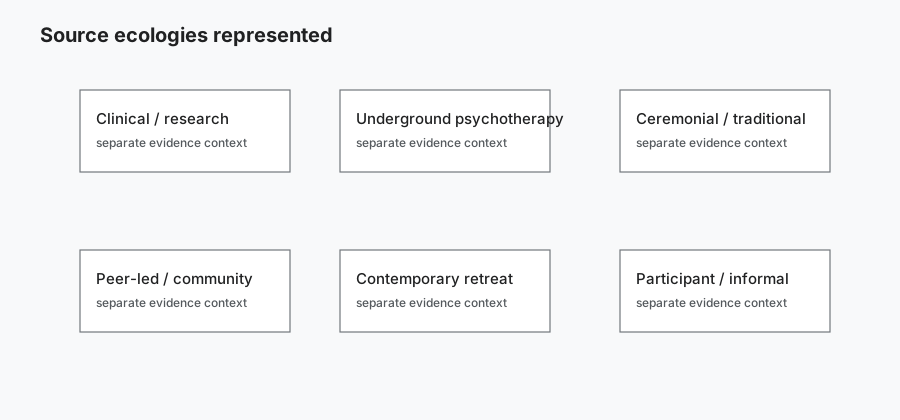
The practices gathered here did not arise from one unified “psychedelic therapy” movement.
In Peru, Takiwasi, founded in 1992, developed a residential addiction-treatment system combining Amazonian medicine, psychotherapy, and community living and work. Its literature describes Amazonian practices such as purgatives, ayahuasca and dietas as components of a broader therapeutic structure rather than presenting a single substance as the entire treatment. [1]
Elsewhere in the Amazonian and Shipibo-associated landscape, organisations such as the Temple of the Way of Light, Nihue Rao and the Ayahuasca Foundation built programmes around ceremonial work, icaros, plant diets, baths or remedies, preparation, and later forms of integration or support. These are not historically interchangeable with psychiatric drug-assisted psychotherapy merely because they also involve psychoactive plants. [2] [3] [4]
A separate lineage developed in Russia. By 1997, psychiatrist Evgeny Krupitsky was describing an eleven-year history of what became known as Ketamine Psychedelic Therapy, initially for alcohol dependence and subsequently for heroin dependence. MAPS later provided funding for part of the heroin study, but the ledger records that the Russian KPT programme already existed before that funding relationship began. [5]
Another ecology operated largely underground. A 2004 investigation of Utah's Wasatch Front described licensed psychologists, social workers and psychiatrists privately using MDMA or other psychedelics with selected psychotherapy clients. One pseudonymous practitioner, “Dr Jane,” was described working with PTSD and histories of childhood physical or sexual abuse; another, “Mike,” discussed more eclectic and relationship-oriented use. [6]
In Switzerland, Friederike Meckel Fischer conducted underground psycholytic psychotherapy after training in the Swiss psycholytic environment of the late 1980s and early 1990s. Only a small proportion of her ordinary psychotherapy clients reportedly progressed into drug-assisted work, particularly when therapy had become “stuck”; the practice subsequently included repeated individual and group sessions extending over years. [7]
Ibogaine developed through yet another mixture of peer practice, underground treatment and later medicalisation. The Rotterdam-based DASH/INTASH network grew from addict-led self-help in the early 1990s; related European networks included the Slovenian Iboga Foundation. Hattie Wells and Patrick Kroupa later wrote from within this broader ibogaine ecology about relapse, aftercare and the limitations of “one treatment” claims. In parallel, Deborah Mash's Healing Visions Institute, opened in St Kitts in 1996, represented a much more medically supervised branch focused on addiction treatment and clinical monitoring. [8] [9]
These distinctions matter throughout the wiki. A peer-led treatment apartment in Rotterdam, a medically supervised offshore ibogaine clinic, a Shipibo retreat centre, an underground Swiss psychotherapist and a modern psychiatric ketamine clinic may all appear in the same corpus, but they should not be retrospectively described as versions of one institution or one therapeutic tradition.
From underground and ceremonial practice to contemporary clinics
By the 2010s and 2020s, more of the corpus consists of visibly institutional clinical programmes.
The MAPS/Lykos MDMA-assisted psychotherapy lineage developed a formal treatment manual and multi-site research programme for PTSD. The ledger treats this as one connected lineage and separately flags practitioners or institutions whose training came directly through MAPS so they cannot later be mistaken for independent origins. [10] [11]
Roots to Thrive, developed from 2018 in British Columbia, embedded ketamine sessions inside a twelve-week group “Community of Practice,” including work with healthcare providers experiencing PTSD and depression. Its own protocol described the community structure as the primary intervention and psychedelic therapy as an adjunct. [12]
Contemporary European clinics such as Psyon in Prague and OVID Clinics in Berlin place ketamine or psilocybin inside broader psychiatric and psychotherapeutic care. OVID's contemporary material includes treatment-resistant depression and trauma-related psychiatric conditions and situates drug-assisted work among individual and group psychotherapy, movement/body approaches, mindfulness, relaxation, and art or music approaches. [13] [14]
At the opposite end of the institutional spectrum, Parklands Mindcare Centre in Nairobi presents ketamine as one tool inside an otherwise conventional psychiatric practice. The centre says its ketamine programme has operated since 2019, addresses severe treatment-resistant conditions including PTSD, and situates ketamine within therapy, medication review, lifestyle support and continuing psychiatric care. [15]
The result is a corpus in which the same drug class can appear in very different institutional forms. The evidence ledger therefore records setting, lineage and practice structure separately from substance.
The vocabulary changed with the setting and period
Historical sources do not consistently use the diagnostic or therapeutic vocabulary now common in psychedelic medicine.
Krupitsky's 1997 material spoke of an eleven-year study of ketamine therapy for “alcohol dependency”, followed by work with heroin dependence. [5]
The 2007-era Proyecto IDEAA literature described work with “toxicomanias” and combined visionary-substance work with Gestalt, humanistic and transpersonal psychotherapy and what its authors called “psycho-spiritual disciplines.” [16]
Brazil's Caminho de Luz, formally founded in 2001, described work around alcohol and drug dependence, family or community reintegration, mutual help, spirituality, education, work activities and ayahuasca sessions. [17]
Contemporary providers more readily use terms such as PTSD, CPTSD, treatment-resistant depression, trauma-informed care, somatic approaches or integration. For example, Mexico's Nierika explicitly lists complex trauma and PTSD associated with systemic violence, organised crime and kidnapping, while the UK-based Emerge Clinic has a dedicated CPTSD treatment page and explicitly notes the limited direct evidence for ketamine-assisted psychotherapy in that condition. [18] [19]
For that reason, this compilation preserves older terminology when discussing older sources. It does not retroactively rename all addiction, childhood-abuse, relational, spiritual or “stuck” psychotherapy cases as complex trauma.
Unequal visibility is part of the evidence problem
Some practices in the corpus are documented through formal papers, manuals and contemporary institutional websites. Others survive through a single newspaper investigation, an archived newsletter, a practitioner website, a conference listing, Blogspot pages, old peer-treatment manuals or participant reports.
The third pass therefore retained informal archives separately from institutions. These include Erowid experience reports, the 2004 Shroomery “Regressive self-therapy using psychedelics?” thread, historical ibogaine micro-sites and manuals, conference/event indexes, Google Groups remnants and the MAPS historical archive. [20]
This unevenness means that amount of surviving text is not treated as a measure of importance or recurrence. Twenty pages from one modern retreat are still one source family; a single contemporaneous 2004 newspaper account can be historically valuable even though it provides much less material. The frozen methodology explicitly prevents multiple pages, shared training relationships or connected institutions from being counted as independent confirmations. [21]
The same caution applies to retrospective history. R. Coleman, for example, is retained because current material describes decades of underground practice, childhood sexual abuse, re-parenting and transference, but the search did not recover comparably detailed contemporaneous documentation from the 1997–2008 period. His claimed historical scale and timing therefore remain retrospective rather than established historical facts. [22]