Scope note
This framework is a tool for understanding and comparing the practices documented in this corpus. It is not a treatment protocol, dosing guide, or self-treatment manual.
No single source contains the framework below. It is derived from the recurring practices and tensions documented in the Pattern Atlas and Cross-Pattern Synthesis.
How to read the framework
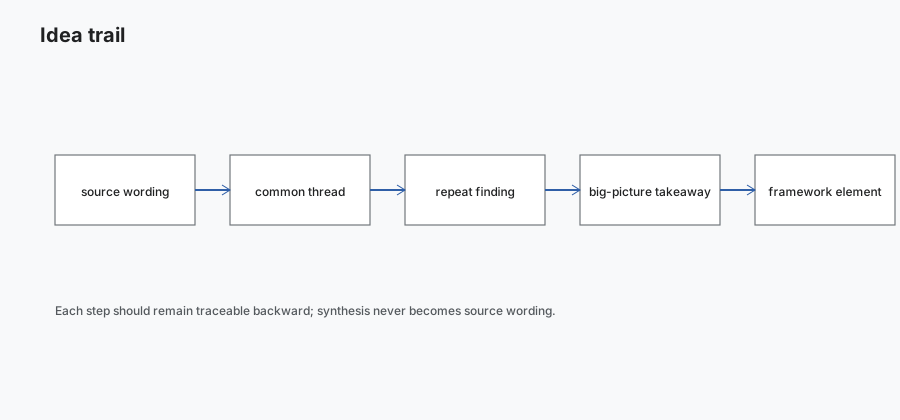
Every framework element is presented at three levels.
SOURCE LANGUAGE
Words or phrases actually preserved from one or more sources.
NORMALIZED CLUSTER
A descriptive label created for this compilation so that differently worded practices can be compared.
SYNTHESIS
A higher-order observation derived from the corpus. This is our analytical layer, not terminology claimed by the original practitioners.
For example:
SOURCE LANGUAGE: “preparation,” “goals,” “expectations,” “safety contract,” “intention-setting”
NORMALIZED CLUSTER: Preparation / readiness
SYNTHESIS: Many otherwise unrelated systems conduct substantial work before the altered state, but they use that period for different purposes.
This structure is intended to prevent the framework's vocabulary from being mistaken for historical source vocabulary.
Framework overview
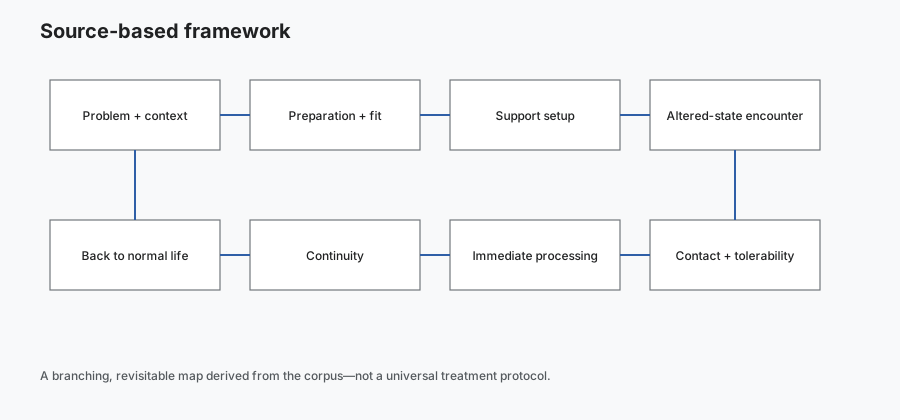
The strongest recurrent architecture in the corpus can be represented as seven interacting zones:
                    ┌──────────────────────────────┐
                    │  0. PROBLEM + CONTEXT       │
                    │  What is being addressed?   │
                    └──────────────┬───────────────┘
                                   │
                                   ▼
                    ┌──────────────────────────────┐
                    │  1. PREPARATION + FIT       │
                    │  readiness • expectations   │
                    │  screening • relationship   │
                    └──────────────┬───────────────┘
                                   │
                         ┌─────────┴──────────┐
                         │                    │
                         ▼                    ▼
              ┌──────────────────┐  ┌─────────────────────┐
              │ 2. CONTAINER     │  │ CONTEXTUAL SUPPORT  │
              │ therapist/guide  │  │ group • ritual      │
              │ peer • medical   │  │ family • community  │
              └────────┬─────────┘  └─────────┬───────────┘
                       └────────────┬──────────┘
                                    ▼
                    ┌──────────────────────────────┐
                    │ 3. ALTERED-STATE ENCOUNTER  │
                    │ minimal ↔ active guidance   │
                    │ participant ↔ lineage       │
                    │ authority over meaning      │
                    └──────────────┬───────────────┘
                                   │
                                   ▼
                    ┌──────────────────────────────┐
                    │ 4. CONTACT + TOLERABILITY   │
                    │ material • emotion • body   │
                    │ openness ↔ overwhelm        │
                    └──────────────┬───────────────┘
                                   │
                                   ▼
                    ┌──────────────────────────────┐
                    │ 5. IMMEDIATE PROCESSING     │
                    │ stabilize • narrate         │
                    │ interpret • embody          │
                    └──────────────┬───────────────┘
                                   │
                                   ▼
                    ┌──────────────────────────────┐
                    │ 6. CONTINUITY               │
                    │ sober therapy • group       │
                    │ repetition • aftercare      │
                    └──────────────┬───────────────┘
                                   │
                                   ▼
                    ┌──────────────────────────────┐
                    │ 7. RE-ENTRY + ENACTMENT     │
                    │ relationships • routine     │
                    │ work • community • care     │
                    └──────────────┬───────────────┘
                                   │
                         ┌─────────┴─────────┐
                         │                   │
                         ▼                   │
                 further sober work         │
                 repeat intervention        │
                 no further substance       │
                         │                   │
                         └───────────↺───────┘
This is deliberately not a one-way treatment pipeline.
Some systems begin with long-established psychotherapy before substance use. Others begin in a community or ceremonial context. Some include repeated altered-state sessions; others use few or no repeat sessions and extend sober treatment instead. Some integrate re-entry into residential life itself rather than treating it as a separate final stage. [1] [2] [3]
0. Problem and context
SOURCE LANGUAGE
The corpus begins from problems described very differently:
- “alcohol dependency”
- heroin dependence
- “toxicomanias”
- PTSD
- complex trauma
- treatment-resistant depression
- childhood physical or sexual abuse
- “stuck” psychotherapy
- fear
- shame
- mistrust / isolation
- psychospiritual concerns
- family/community reintegration
These categories came from very different systems and should not be retroactively merged into one diagnosis. Krupitsky's historical KPT work addressed alcohol and later heroin dependence; IDEAA used the vocabulary of toxicomanias; the Wasatch practitioners described PTSD and childhood abuse; Fischer described some clients as “stuck”; Nierika explicitly names complex trauma/PTSD in contexts including systemic violence; and contemporary psychiatric clinics often describe treatment-resistant conditions. [4] [5] [6] [2] [7]
NORMALIZED CLUSTER
Problem + context
This cluster asks what the intervention is actually intended to address and what social, clinical or cultural system defines the problem.
SYNTHESIS
A substance-assisted practice cannot be understood solely by asking what substance is used.
The same substance can appear in addiction treatment, psychotherapy, psychiatry, ritual practice, personal development or community-health work. Conversely, similar problems can be approached through completely different substances and institutional settings.
KRIYA's distinction between biochemical/medical, psychotherapeutic/psycholytic and psychedelic ketamine paradigms is especially useful here because it shows that the same molecule does not define one intervention. [8]
Decision point: What problem does this approach think it is solving?
Possible orientations in the corpus include:
| Orientation | Examples in corpus |
|---|---|
| Acute dependence / interruption | early ibogaine networks, Healing Visions |
| Addiction + wider life reconstruction | Takiwasi, Caminho de Luz, Tabula Rasa |
| PTSD / trauma-focused psychotherapy | MAPS/Lykos, Wasatch, Emerge |
| Treatment-resistant psychiatric illness | Psyon, OVID, Parklands, South Island |
| Relational / stalled psychotherapy | Fischer, Feldmár |
| Psychospiritual / initiatory work | Bwiti House, Wasiwaska |
| Community/cultural mental health | Nierika |
Workbook
When examining a programme or historical practice:
What problem does it say it addresses?
Is that a diagnosis, a behaviour, a relationship problem, an existential concern, a social problem, or some mixture?
Whose definition of the problem is being used—the patient, clinician, community, healer, institution or religious tradition?
Is substance use the central treatment, an adjunct, one ritual component, or simply one event inside a larger system?
Does the provider's language match the population actually being treated?
Cross-links:
Pattern Atlas: substance inside a larger system · Glossary: treatment model · Glossary: CPTSD
1. Preparation and fit
SOURCE LANGUAGE
Across sources:
- preparation
- psychoeducation
- intake
- application
- screening
- intentions
- intention-setting
- goals
- expectations
- risks / benefits
- personal history
- vulnerabilities
- safety contract
Russian KPT used preparatory psychotherapy/education; the 2004 Wasatch case involved six earlier preparation sessions, goals and a safety agreement; Fischer used psychoeducation and sober intention-setting; the Ayahuasca Foundation explicitly separates “preparation, participation, and integration”; Tandava uses a multi-week preparation period; contemporary psychiatric and retreat programmes add screening and suitability procedures. [4] [6] [2] [9] [10]
NORMALIZED CLUSTER
Preparation / readiness
SYNTHESIS
The corpus contains at least four distinct things called, or functioning as, preparation.
                   PREPARATION
                        │
         ┌──────────────┼──────────────┐
         │              │              │
         ▼              ▼              ▼
      MEDICAL      PSYCHOLOGICAL    RELATIONAL
    suitability      history           trust
     screening      intentions        familiarity
       risks           goals          expectations
         │              │              │
         └──────────────┼──────────────┘
                        ▼
                  PRACTICAL/RITUAL
                  diet • logistics
                  conduct • support
They should not be collapsed into a single intervention.
Branch: medical readiness
Healing Visions emphasized medical monitoring and cardiac oversight for ibogaine; Etnikas combines ceremonial work with physician/nursing oversight; Parklands uses conventional psychiatric assessment and monitored ketamine. [11] [12] [13]
Branch: psychological preparation
Wasatch, Fischer, MAPS and Equanimity all describe some combination of life history, goals, expectations, vulnerabilities or therapeutic preparation. [6] [2] [14] [15]
Branch: relational preparation
The preparation period can also be the period in which therapist and participant become familiar enough for later vulnerability.
This interaction is strongly visible in the Wasatch, Fischer and MAPS material, although the corpus does not establish that preparation automatically creates trust.
Workbook
What does “preparation” mean in this approach?
Mark all that apply:
medical · psychological · relational · ritual · practical · social
How much contact exists before the altered state?
Are goals generated by the participant, practitioner, programme or tradition?
Are risks and failure possibilities discussed, or only desired outcomes?
Does preparation test suitability or merely prepare the person to proceed?
Is there already enough relationship for disagreement, fear or withdrawal to be expressed safely?
Cross-links:
Pattern Atlas: Preparation · Pattern Atlas: Screening · Glossary: preparation
2. The container: relationship and surrounding structure
SOURCE LANGUAGE
- trust
- therapeutic alliance
- empathic presence
- listening
- trusted friend / relative
- “containing element”
- “Holding Space and Non-Intervention”
- reassurance
- grounding
- “voice & choice”
- community
- group
- family / social networks
Fischer described her husband's relatively passive presence as a “containing element.” The Wasatch case included a trusted friend or relative after the session. MAPS emphasizes alliance and empathic presence. The Temple uses “Holding Space and Non-Intervention.” Tandava uses “voice & choice.” Roots to Thrive places the person inside a Community of Practice. [2] [6] [14] [16] [10] [3]
NORMALIZED CLUSTER
Container / relational support
SYNTHESIS
The container can be thought of as the answer to:
What, and who, surrounds the person when ordinary control or orientation becomes less reliable?
The corpus contains several non-equivalent container types:
                       CONTAINER
                           │
        ┌──────────────────┼──────────────────┐
        │                  │                  │
        ▼                  ▼                  ▼
    RELATIONAL           SOCIAL             MEDICAL
 therapist / guide      group / peers      monitoring
 trusted person         family              assessment
 continuity             community           physiological safety
        │                  │                  │
        └──────────────────┼──────────────────┘
                           ▼
                       RITUAL
                 lineage • ceremony
                 songs • prayer • rules
The important recurring feature is not that all programmes use the same container. They plainly do not.
The recurrence is that many programmes make the surrounding structure an explicit part of the intervention.
Workbook
Who is physically or relationally present?
Is that person primarily a therapist, monitor, witness, healer, peer, friend or authority figure?
Does the same practitioner remain involved before and afterward?
What forms of disagreement or refusal are available?
What happens if the person becomes frightened, confused or overwhelmed?
Does the programme define safety primarily as psychological, medical, spiritual, social—or some combination?
Cross-links:
Pattern Atlas: Relational safety · Pattern Atlas: Group/community · Glossary: container
3. The altered-state encounter
This is the most important branching point in the framework because the corpus contains genuinely incompatible practice philosophies.
SOURCE LANGUAGE
Low-directiveness language includes:
- “Holding Space and Non-Intervention”
- “No pressure to ‘go deeper’”
- “invitation rather than direction”
- “inner healing intelligence”
- “the source of their own healing”
- non-directive / supportive
More active language includes:
- intensive psychotherapy
- questions probing trauma material
- healer diagnosis
- individualized icaros
- workshops
- “Fire Talk”
- psychodynamic / somatic / interactional approaches
NORMALIZED CLUSTER
Acute-state facilitation style
SYNTHESIS
The corpus contains at least five distinct acute-state styles:
| Style | Practitioner role | Representative corpus examples |
|---|---|---|
| Medical/minimal | administer/monitor; comparatively little visible psychotherapy | South Island, Healing Visions |
| Protective/non-directive | remain available, reassure, avoid imposing direction | Temple, MycoMeditations, MAPS elements |
| Responsive | engage when material appears | Wasatch-type psychotherapy |
| Actively psychotherapeutic | substantial therapy occurs during altered state | Fischer; PSIP orientation |
| Ritual-active | music, ceremony, diagnosis, teaching or spiritual practices actively shape the experience | Shipibo settings, Bwiti House |
These are descriptive categories created for this compilation, not source-defined schools.
Infographic — acute-state branching
                     ALTERED STATE
                          │
          ┌───────────────┼────────────────┐
          │               │                │
          ▼               ▼                ▼
       MINIMAL         RESPONSIVE        ACTIVE
       monitor         follow what       therapist
       protect         emerges           intervenes
          │               │                │
          └───────────┬───┴───────┬────────┘
                      │           │
                      ▼           ▼
                 RITUAL-ACTIVE   MEDICAL
                 ceremony/song   physiological
                 diagnosis       oversight
These branches can coexist. The Temple, for example, combines psychologically non-intrusive Western facilitation with active Shipibo ritual practice. [16]
Decision point A — How directive is the facilitator?
Low directiveness: participant process is intentionally protected from practitioner direction.
Intermediate: practitioner responds but does not continuously steer.
High: psychotherapy or another active intervention occurs during the altered state.
There is no corpus-wide agreement about which is preferable.
Decision point B — Who owns meaning?
SOURCE LANGUAGE
- “we do not inform our clients on the meaning of their experiences”
- Evolving Temple also presents meaning-making as participant-led; the exact quotation preserved in earlier drafts was not reverified and is omitted here.
- “inner healing intelligence”
- healer “Diagnosis in the first ceremony”
- regression / shadow frameworks
- spiritual or traditional teaching
NORMALIZED CLUSTER
Interpretive authority
SYNTHESIS
 PARTICIPANT-OWNED      COLLABORATIVE        FRAMEWORK-LED       LINEAGE-LED
 meaning emerges   →   therapist + person → psychological lens → ritual/cosmology
No position is treated here as inherently superior.
The point is that authority over meaning is part of the treatment architecture, even when it is not explicitly discussed.
Workbook
During the experience, what is the facilitator expected to do?
Can the participant refuse guidance?
Does the programme distinguish support from interpretation?
Who is treated as the final authority on what imagery, memory, sensation or spiritual material means?
Is a particular worldview assumed in advance?
Does the source clearly separate experience from claims about historical fact?
Cross-links:
Pattern Atlas: Acute-state styles · Pattern Atlas: Meaning · Glossary: non-directive · Glossary: interpretive authority
4. Contact with difficult material and the problem of tolerability
SOURCE LANGUAGE
- “stuck”
- “defensive walls”
- psychotherapy becoming “faster” or “deeper”
- “loosened me up behaviorally, emotionally and posturewise”
- “too much to deal with too fast”
- “No pressure to ‘go deeper’ or process beyond your capacity.”
- processing material that “arose during or after” the experience
NORMALIZED CLUSTER
Access ↔ tolerability
“Access” is our label, not a single term consistently used by the sources.
SYNTHESIS
Several sources describe difficult-to-reach speech, emotions, psychological material or flexibility becoming more available.
The informal corpus simultaneously preserves examples in which the amount of material encountered was experienced as excessive.
The framework therefore avoids:
more intensity = more therapeutic
and instead records the tension:
            MATERIAL BECOMES MORE AVAILABLE
                         │
             ┌───────────┴───────────┐
             │                       │
             ▼                       ▼
         TOLERABLE               OVERWHELMING
     can remain engaged        “too much … too fast”
             │                       │
             ▼                       ▼
      possible processing      destabilization /
                              impaired functioning
This diagram is descriptive, not a validated dose-response model.
Decision point
The useful question is not simply:
How deep was the experience?
but:
What happens when difficult material becomes available?
Workbook
Does the programme explicitly discuss pacing?
What language does it use for difficulty—resistance, defense, dissociation, fear, trauma, spiritual challenge, something else?
Is “going deeper” treated as inherently desirable?
Can the participant stop or slow an intervention?
What happens when more material emerges than expected?
Does the programme distinguish psychological intensity from therapeutic usefulness?
Cross-links:
Pattern Atlas: Access/openness · Safety appendix: flooding · Glossary: tolerability
5. Immediate processing after the altered state
SOURCE LANGUAGE
- integration
- aftercare
- follow-up
- processing
- group sharing
- written report
- “deepening awareness”
- guided imagery
- art therapy
- meditation
- mindfulness
- journaling
- reflection
Russian KPT used subsequent psychotherapy; early ibogaine material used “aftercare”; Fischer reserved Sunday for sober integration; Psyon runs an eight-week post-ketamine group focused on “processing important issues and deepening awareness of content that arose during or after the ketamine experience.” [4] [24] [2] [25]
NORMALIZED CLUSTER
Immediate processing
SYNTHESIS
The modern word integration hides several distinct jobs.
                 AFTER THE ALTERED STATE
                           │
       ┌───────────────────┼────────────────────┐
       │                   │                    │
       ▼                   ▼                    ▼
   STABILIZE            NARRATE             INTERPRET
 rest / ground       describe/share       develop meaning
       │                   │                    │
       └──────────────┬────┴───────┬────────────┘
                      ▼            ▼
                   EMBODY       ORGANIZE
                 movement/body  plans / decisions
Not every programme performs all of these functions.
And the order may matter in practice, but the corpus does not establish a universal sequence.
Branch: stabilization
Grounding, rest, reassurance, bodily regulation or simple recovery.
Branch: narration
Talking, sharing circles, written accounts or group processing.
Branch: interpretation
Psychological, narrative, symbolic or spiritual meaning-making.
Branch: embodiment
Meditation, bodywork, movement, yoga, breathwork or other non-verbal processes.
Workbook
What happens in the first hours or day afterward?
Is the person expected to interpret the experience immediately?
Is there time simply to recover or describe what happened?
Does interpretation come from the participant, therapist or tradition?
Are bodily or emotional states treated separately from narrative meaning?
What happens when the experience remains confusing?
Cross-links:
Pattern Atlas: Post-session processing · Glossary: integration · Glossary: aftercare
6. Continuity and longitudinal work
SOURCE LANGUAGE
- follow-up
- repeated sessions
- weekly
- monthly
- years
- aftercare
- integration over weeks
- alumni/community
- repeat treatment
- “It takes time to get to know and to be with a substance”
- criticism of “one treatment” claims
Fischer's group averaged roughly 25 drug-assisted sessions over several years. Early ibogaine writers explicitly criticized one-treatment narratives. Roots to Thrive uses a twelve-week structure with three ketamine sessions; Psyon follows ketamine with eight weeks of group work; Tandava uses a seven-week container; Evolving Temple advertises weeks of preparation and integration around its ceremonies. [2] [26] [3] [25] [10] [19]
NORMALIZED CLUSTER
Continuity / longitudinal support
SYNTHESIS
The recurrent lesson is not “repeat the substance.”
The corpus contains at least four ways to extend treatment:
                    LONGITUDINAL WORK
                           │
       ┌───────────────────┼────────────────────┐
       │                   │                    │
       ▼                   ▼                    ▼
  REPEAT SUBSTANCE     SOBER THERAPY       GROUP/COMMUNITY
      sessions            contact              contact
       │                   │                    │
       └──────────────┬────┴───────┬────────────┘
                      ▼            ▼
                 HOME CLINICIAN   RETURN VISITS
                 /continuity      when needed
Fischer occupies one extreme: many drug-assisted sessions integrated into years of therapy.
Roots to Thrive occupies another: relatively few ketamine sessions inside a substantially larger group intervention.
MycoMeditations' “Bridge” creates continuity by connecting retreat work to the participant's home practitioner. [27]
Workbook
What continues after the acute experience?
What is repeated: the substance session, psychotherapy, group contact, community practices, or all of them?
How long does support last?
Who remains available?
Is return treatment framed as expected, optional, failure, maintenance or something else?
Does the programme depend on an intense event or on a longer arc?
Cross-links:
Pattern Atlas: Repetition · Glossary: longitudinal care
7. Re-entry and enactment in ordinary life
SOURCE LANGUAGE
- everyday life
- relapse prevention
- family / relationships
- lifestyle change
- continued psychiatric care
- home therapist
- family/community reintegration
- work / vocational activity
- community living/work
- health promoters
- alumni/community
- post-dieta conduct
KPT explicitly directs subsequent psychotherapy toward everyday life. Takiwasi makes community living/work part of treatment itself. Tabula Rasa includes relapse prevention and relationships in aftercare. MycoMeditations creates continuity with home therapists. Parklands describes a “window for therapy, lifestyle change, and continued psychiatric care.” Caminho de Luz includes labour/vocational activity and family/community reintegration. Nierika trains community members as health promoters. [4] [1] [28] [27] [13] [29] [7]
NORMALIZED CLUSTER
Re-entry / enactment
SYNTHESIS
The corpus repeatedly distinguishes—sometimes explicitly, sometimes structurally—between:
        SOMETHING CHANGES IN THE EXPERIENCE
                       │
                       ▼
        SOMETHING MUST HAPPEN IN ORDINARY LIFE
The second problem may involve:
- maintaining sobriety;
- continuing therapy;
- changing routines;
- returning to family;
- managing relationships;
- work or vocational life;
- psychiatric follow-up;
- remaining inside a supportive community;
- adapting the surrounding environment.
The corpus does not establish that subjective insight automatically produces these changes.
Infographic — processing versus re-entry
        IMMEDIATE POST-STATE                     RE-ENTRY

       “What happened?”                    “What happens now?”

        stabilize                            relationships
        describe                             routines
        share                                work
        interpret                            substances
        understand                           psychiatric care
        embody                               family/community
             │                                      │
             └──────────── not identical ───────────┘
Takiwasi is an important exception to the neat division: because community living and work are already part of residential treatment, “re-entry” is partly practiced inside treatment rather than reserved for discharge. [1]
Workbook
Where does the person go after the intervention?
Does the original social environment change at all?
Is there a home therapist or clinician?
Are relationships, work, routine or relapse explicitly addressed?
What happens if the person's environment reinforces the previous pattern?
Is the programme's model of “integration” primarily reflective, or does it include actual life changes?
How does the programme know whether change persisted?
Cross-links:
Pattern Atlas: Aftercare and re-entry · Glossary: re-entry
The framework's four major branching questions
The entire corpus can be navigated using four questions.
1. What is the substance supposed to be doing?
The sources imply very different positions.
Medical effect
The substance is primarily a pharmacological treatment.
Catalyst / amplifier
Roots to Thrive explicitly uses “amplifier and therapeutic catalyst.” [3]
Psychotherapeutic access
The altered state is used within psychotherapy.
Ceremonial / spiritual intervention
The substance participates in a larger ritual healing system.
One component of a multidimensional programme
Takiwasi's “tripod,” OVID's “not … psilocybin in isolation,” and Parklands' “Ketamine is not a cure” all exemplify this broader positioning. [1] [30] [13]
2. How much does the practitioner intervene?
minimal ───────── supportive ───────── responsive ───────── active
Separate from that continuum is ritual activity, which can be highly active without resembling psychotherapy.
3. Who owns interpretation?
participant → collaborative → therapeutic framework → ritual/cosmological authority
The sources genuinely disagree.
The framework therefore preserves this question instead of pretending there is one accepted “integration” style.
4. Where is change expected to occur?
inside acute experience
        │
        ├── in later psychotherapy
        │
        ├── in the body / behavior
        │
        ├── in relationships
        │
        ├── in group/community
        │
        └── in the person's wider life
This is one of the clearest differences between substance-centred and context-centred models.
Comparison worksheet
This table can be duplicated whenever two programmes, practitioners or historical systems need to be compared.
| Dimension | Approach A | Approach B |
|---|---|---|
| Problem being addressed | ||
| Source terminology | ||
| Historical period / place | ||
| Formal / underground / ceremonial / peer-led | ||
| Substance's stated role | ||
| Preparation | ||
| Medical screening | ||
| Psychological screening | ||
| Relationship before session | ||
| Acute-state directiveness | ||
| Who owns meaning? | ||
| Body / movement / ritual elements | ||
| Group / community role | ||
| Immediate processing | ||
| Longitudinal support | ||
| Re-entry / home environment | ||
| Failure/adverse-response pathway | ||
| Evidence type | ||
| Verification level | ||
| Lineage dependencies | ||
| What cannot be established |
Programme-reading workbook
When encountering a new substance-assisted programme, the reader can work through the following questions without assuming that it resembles any existing model.
A. Problem
What does the programme claim to treat or change?
What terminology does it use?
Does that terminology belong to the programme's historical period, or is it modern language applied retrospectively?
B. Substance
Is the substance presented as medicine, catalyst, sacrament, psychotherapeutic tool, initiatory agent or something else?
Would the programme still make conceptual sense if the substance were removed?
This is an analytical question—not a recommendation to alter treatment.
C. Preparation
What happens before the altered state?
How many different purposes are hidden under “preparation”?
Is trust already established before vulnerability increases?
D. Container
Who or what surrounds the participant?
therapist · doctor · guide · healer · friend · group · community · ritual lineage
What happens if the participant rejects the facilitator's framing?
E. Acute-state facilitation
Does the practitioner mostly protect, respond, actively intervene, perform ritual work, or medically monitor?
Does the public description match practitioner behavior as described by participants?
F. Access and tolerability
How does the approach respond when difficult material appears?
Does it valorize intensity?
Is there an explicit ceiling on how far the participant should be pushed?
G. Meaning
Who is allowed to interpret what happened?
Does the system distinguish subjective truth from factual/historical claims?
H. Processing
What does “integration” actually consist of?
Check individually:
stabilization
narration
interpretation
body work
psychotherapy
group sharing
behavior planning
I. Continuity
How much contact remains after the acute experience?
What is repeated—medicine, therapy, community, practices, or nothing?
J. Re-entry
How does the model address ordinary life?
What happens to relationships, work, substance use, psychiatric care, community and routine?
Does the intervention end at the retreat/clinic door?
K. Evidence
Who is describing the practice?
provider · participant · journalist · researcher · peer network
Is the source contemporaneous or retrospective?
Does the apparent recurrence actually come from several independent ecologies?
Could the pattern simply reflect one highly visible lineage?
Reading the framework as a whole
The framework should not be read as:
prepare correctly → take substance → process trauma → integrate → recover.
The corpus does not justify that sequence.
A more faithful representation is:
                     EXISTING PROBLEM
                           │
                           ▼
                  preparation / selection
                           │
               ┌───────────┴────────────┐
               ▼                        ▼
         relationship              wider container
               │                        │
               └───────────┬────────────┘
                           ▼
                   altered-state event
                           │
              ┌────────────┼───────────────┐
              │            │               │
              ▼            ▼               ▼
         little material  tolerable      overwhelming
          or change       engagement        material
              │            │               │
              └──────┬─────┴───────────────┘
                     ▼
           post-state processing
                     │
          ┌──────────┼───────────┐
          ▼          ▼           ▼
       sober       group       continued
       therapy     support     observation
          │          │           │
          └──────────┼───────────┘
                     ▼
                   re-entry
                     │
          ┌──────────┼────────────┐
          ▼          ▼            ▼
      changes     no change    destabilization /
      persist     or fade      relapse / mismatch
          │          │            │
          └──────────┴─────┬──────┘
                           ▼
                  further decisions
The final row is especially important.
The sources include successful, ambiguous and adverse accounts. The framework therefore leaves open multiple outcomes rather than treating continued progress as the default.
What the framework can legitimately generalize
The corpus supports a cautious general statement:
Across multiple independent clinical, underground, ceremonial, peer-led and community-based ecologies, substance-assisted practices frequently place the altered-state event inside a larger architecture involving some combination of preparation, selection, human or ritual containment, post-state processing, longitudinal support and return to ordinary life. [1] [3] [14] [4] [24]
The corpus also supports a second statement:
Those ecologies disagree substantially about what the altered state is for, how actively another person should intervene, who has authority to interpret the experience, how much repetition is desirable, and whether the decisive work occurs inside the session, afterward in psychotherapy, or in the person's social and practical life.
Those disagreements are part of the framework rather than exceptions to it.
What the framework does not establish
It does not establish:
- that every framework element is necessary;
- that programmes containing more elements are better;
- that the substance is merely incidental;
- that psychological “depth” predicts outcome;
- that repeated substance exposure improves outcomes;
- that group treatment is superior to individual treatment;
- that one acute-state facilitation style is safest or most effective;
- that vivid autobiographical material is historically accurate;
- that participant-owned or practitioner-owned interpretation is universally preferable;
- that practices recurring across many settings are effective simply because they recur.
The framework maps what people repeatedly built around these interventions and where their approaches diverged.
It does not convert recurrence into efficacy.
Navigation
Evidence behind this framework
Why these approaches were undertaken
Recurring patterns and their origins
Terms
Glossary: preparation
Glossary: container
Glossary: integration
Glossary: aftercare
Glossary: re-entry
Glossary: non-directive
Glossary: interpretive authority
Limitations